@heatherspeakandsign

@heatherspeakandsign

Thursday, November 21, 2024

ASL Fingerspelling: Thanksgiving I Have...Who Has Game


Last month I shared an ASL fingerspelling, Halloween-themed "I Have...Who Has?" game that I downloaded on Teachers Pay Teachers.  My students loved it so much that they asked me if I had one for Thanksgiving.  I looked and none were available.  So, I created my own.  I made the cards much bigger so that the fingerspelling font is easier to read.  My game has 14 cards from start to finish.  I definitely need to work on my formatting, but I am very happy with the final product and can't wait to play it this week and next with my students.  It targets thematic vocabulary in both ASL and spoken English, along with expressive and receptive fingerspelling (which I always need to practice).  


Monday, November 18, 2024

Alphabet Puzzle - Auditory and Early Reading Skill Development


Alphabet letters are an instant closed set of minimal pairs, perfect for targeting auditory skill development.  The letters B, C, D, E, G, P, T, V, and Z are one set of minimal pairs.  A, H, J, and K are another set.  F, L, M, N, S, and X for yet another set.  You can readily target discrimination and identification using letters.  By using words, you can also target auditory memory and sequencing.  I have a set of CVC (consonant-vowel-consonant) words with pictures that I downloaded.  I have two foam letter alphabet puzzles, one uppercase and one lowercase, that I picked up at a dollar store.  The student and I typically pop all the letters out onto the table but keep them in alphabetical order.  I then put three post-its on the table in front of the student labeled "1", "2", and "3".  Next, I present the three letters that make up the target word from behind my acoustic hoop.  Once the student has identified the letters and placed them on the post-its in the correct order, we practice tapping out and blending the sounds to read the word.  This may take several presentations and possibly the addition of sign language.  All good data to keep.  If the student is not able to successfully tap or blend, I model it.  Once the word has been stated, I ask the student to sign it if they can so I can check for comprehension.     


Wednesday, November 13, 2024

Formulating Questions: Thanksgiving...Guess Who? Guess What?


Formulating questions using appropriate English grammar is extremely challenging for my students with hearing loss.  My students often omit the auxiliary or use the incorrect form when asking questions (ex. "You have?" vs. "Do you have", do/does/did).  They also struggle with word order, most often leaving words in statement order and using rising intonation (ex. "It is..." vs. "Is it?").  Playing games like "Guess Who" are great for practicing question formation.  Even better, you can work on pronouns (he/she) and verb agreement (has/have).  If you watch the video you will see I use signed English rather than ASL.  This is done to visually highlight the grammar, function words, and word order.  

This Thanksgiving version of "Guess Who" and "Guess What", created by K Ratliff, are available on Teachers Pay Teachers for free download.  They are available for a variety of holidays and season.  These holiday and seasonal versions are a fun, motivating way to practice question formation, pronoun use, and verb agreement while also targeting relevant vocabulary.  I try to encourage the students to think categorically or look for similarities so that they can eliminate more than one picture at a time.  I have the students use Bingo markers to cover up the pictures that they have eliminated.   

This activity is also great for working on auditory skill development with students that are Deaf and Hard of Hearing.  It has a closed visual set to support listening, while targeting sentence level discrimination and comprehension.  


Tuesday, November 12, 2024

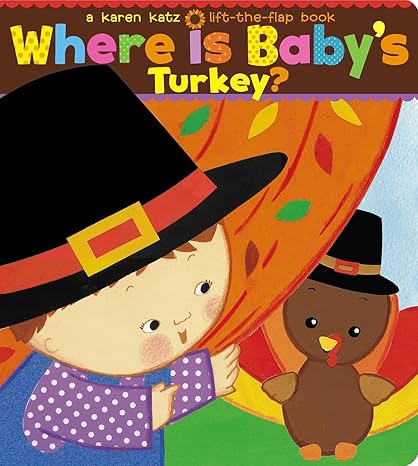
Where is Baby's Turkey?


Yep...there's another one!!! "Where is Baby's Turkey?" from the Karen Katz lift-the-flap series is another book I like to read this time of year in therapy sessions.  Lift-the-flap books continue to be one of my favorite ways to engage with preschoolers, target vocabulary, and elicit communication.  I hold them out of reach so the students need to make a request to see/look.  This particular Karen Katz series is great for working on seasonal and holiday vocabulary as well as location words (in, under, behind, etc.).  We fold in some core language as well, including want, turn, my/your/I, see, open, and more, and target expanding utterances to request (ex. I want see/look, behind the gate).  It is highly relatable, simple, predictable, and visually appealing.  


Thursday, November 7, 2024

Thanksgiving Penny Pushers


This is a repost of information I shared in "Back to School - Penny Pushers".

Penny Pushers are another favorite activity I use for receptive language (any student) and auditory skill development (Deaf and Hard of hearing students).  Depending on the language level of the students, I typically use this with Knd-2nd graders, but have had older students for whom this was still very appropriate.  This activity was created by K Ratliff and is available for free download on Teachers Pay Teachers.  Penny Pushers are available for all four seasons and a variety of holidays as well.  Each set comes with around eight different stories that are approximately 3-5 sentences in length, so the activity is quick and repeatable within and across therapy sessions. 

I start by giving each student participating a laminated copy of the response chart.  I then give each child four pennies.  While the students often want to put them on the penny illustrations at the top, I find it more helpful to place them on the "wh" question words along the side.  This is a better visual representation of one per row.  If I am working with more than one student, I put up some kind of visual barrier so that they can't see each other's responses.  I tell them that I want everyone to do their own thinking.  Before I read/sign the story, we typically go over the possible response options for each row to make sure they understand the targeted vocabulary.  The "when" row usually needs the most attention, particularly for students who are not yet reading words at that level (Thursday, November, etc.).  

Once we've established that the students understand the possible response options, it's time to read and/or sign the story.  I always remind them that the rule is not to do anything but listen/watch until I say, "Slide your pennies!"  If I am targeting auditory comprehension with my Deaf and Hard of Hearing students, then the first 1-2 presentations will be using my acoustic hoop so that it is a true listening task or present it orally without sign support.  While this is a challenging listening task, having the pictures for support aids in word discrimination and identification.  If I notice that one of my Deaf/HoH students has only 1-2/4 correct, then I will reread the story with sign support to ensure comprehension regardless of mode.  After the story has been presented, we go over the correct answers, with each child getting a chance to go first for at least one question.  Some children choose to share how they did, but the barriers allow for each student's performance to remain private.  For the "who" row, I often ask them how they knew it was a boy/man vs. girl/woman vs. more than one person so we can highlight the pronouns used within the story (she/her/hers, he/him/his, they/them/their).  And, of course, if everyone gets 4/4 then we all stand up and do a "winners dance"!!!       


Tuesday, November 5, 2024

Thanksgiving Songs


"Thank You Song" (tune of "Twinkle, Twinkle, Little Star")

Thank you for the sun so bright.
Thank you for the moon at night.
Thank you for my family.
Thanks for friends who play with me.
Thanks for everything I see.
I am thankful, yes sirree!


"Hello Mr. Turkey!" (tune of "If You're Happy and You Know It")

Hello, Mr. Turkey, how are you? (clap, clap)
With a gobble, gobble, gobble and a wobble, wobble, wobble.
Hello, Mr. Turkey, how are you? (clap, clap)

"I'm Glad I'm Not a Turkey" (tune of "Did You Ever See a Lassie?")

Oh, I'm glad I'm not a turkey, a turkey, a turkey.
I'm glad I'm not a turkey on Thanksgiving Day.
They stuff you and bake you,
And then they will taste you.
Oh, I'm glad I'm not a turkey on Thanksgiving Day!


"Gobble, Gobble" (tune of Military Chant)

Gobble, gobble is the sound (repeat)
Of the turkey fat and round (repeat)
Thanksgiving Day will soon be here (repeat)
Then he'll surely disappear (repeat)
Sound off...1, 2
Sound off...3,4
Bring it on down....4,3,2,1...Gobble! Gobble!


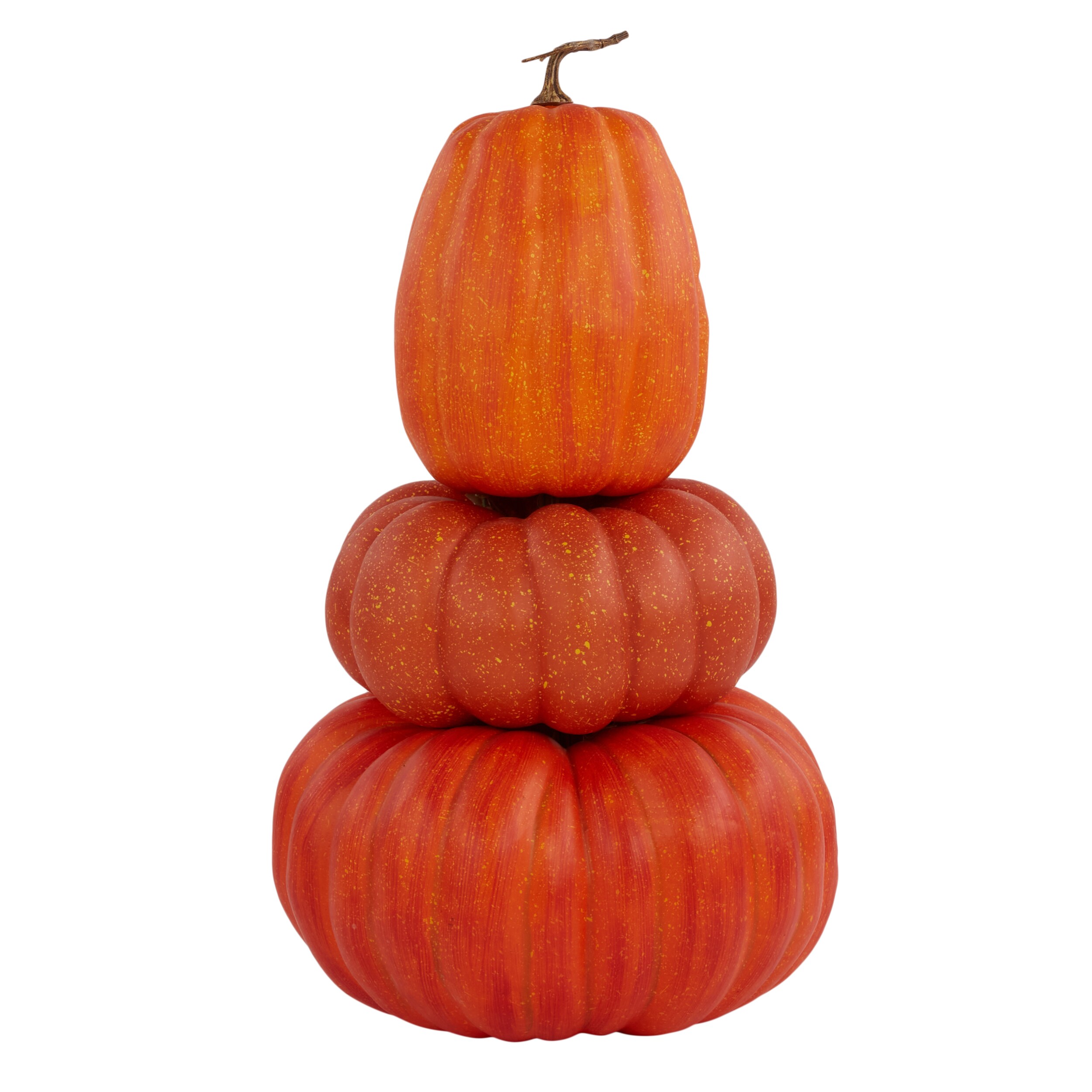
Three Pumpkins Identifying Similarities Extension Activity


This was a free activity I downloaded targeting categorization/identifying similarities.  I like to use it in small group therapy with 2-3 students.  To target auditory memory and sequencing, I state the three items on the card  and have the first student repeat them back in correct order.  For my Deaf and Hard of Hearing students working on auditory skill development (discrimination/identification/comprehension), I will present the words using from behind my acoustic hoop.  If there are three students in the group, I then have the second student identify how the three items are related/similar.  The third student is then asked to name an additional item that could fit into the category.  If there are only two students in the group then I combine the first two "jobs".  If you have four students, I make the fourth student the "judge" who decides if all responses were accurate.  Involving all the students in the group in each turn, promotes everyone paying attention and remaining engaged not only when I am talking/signing, but also when peers are as well.    


Valentine’s Barrier Activity

  This is a great and challenging activity for upper elementary students and even middle school students as well.  I give each student a bla...