
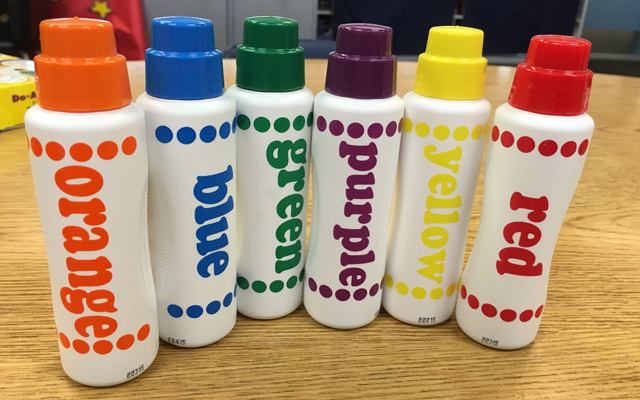

I love to use these paint dabbers to drill/practice any kind of skill requiring high repetitions. Students of all ages/grades seem to love this activity. First, I select and print out seasonal/theme-based printables. There are many available for free on the internet. I typically grab them off of Teachers Pay Teachers. I try to have at least 3-5 options for the student to choose, so that they are more invested and so that I can elicit the language required to make that choice (ex. I want ___.). So, for back to school, I might present a school bus, backpack, and crayons. Once the child has made their choice, we start practicing the targeted skill.
My students have all learned that we do things in 3's in my room. They learned 1, 2, 3...GO! with the wind-up toys. With paint dabbers, they learn 1, 2, 3...STOP! So, whatever skill we are targeting they practice it three times. If we're targeting word-final /t/, then I will put out three articulation cards or scroll through three pictures of final /t/ words on my i-Pad. If we are targeting is/are +verb ending -ing, then I will lay three verb/action cards out on the table.
Once they have completed their three practice tasks, then it's time to paint. For my younger students that are still building their vocabulary and working to expand their utterances, I will hold the basket containing the paint dabbers just out of reach but fully visible. If they don't yet know their colors expressively, I will let them point to/touch the one they want but not take it. Once they have made their request, I hand them the paint, making sure the cap is nice and tight. Again, for my younger students, I am hoping to build in an opportunity to request help to open it. My OT coworkers also love these dabbers because they are great for targeting the two hands working together and the fine motor needed to turn and open them. When the student has the paint and opened it, we paint for a count of three and then stop ("1, 2, 3...STOP!"), put the top on, and return the paint to the basket. They get one color per turn. For the younger students, they may actually paint well more than three dots, but the point is that they stop after the count of three. As the students get older, and they are building their understanding of 1:1 correspondence, then we focus on only painting three dots. Eventually they understand that because they practiced their target skill three times, they can paint three dots. This often leads to the students negotiating. For example, if they are painting the bus and the wheel has four circles and they want them all to be the same color, they might indicate wanting to finish it or do one more. I can then elicit one more practice of their target skill to "earn" that extra dot.
Core language and early concept targets include want, more, turn, help, open/close, on/off, go/stop, colors, theme-based vocabulary (pictures you print), and 1:1 correspondence.


No comments:
Post a Comment